Wednesday, November 20, 2013

Salesforce in a Nuthsell from Dreamforce 2013

Having just spent the day at Dreamforce I was struck by the incredible breadth of the offerings at Salesforce.  And, for the life of me I couldn’t find a single document to help me keep them straight.  So, with some help form @halesalesforce (thanks Will!) I’ve built out this quick and dirty diagram for those of you still at Dreamforce to navigate all of the new offerings:
The major theme of the company this year is integration.  In the past Salesforce has focused on storage in the Cloud.  Now they have the data, and need to integrate it into a cohesive system.  Every customer I talked to underlined this as the primary pain and the vast majority of partners at the Dreamforce expo were focused on this.  So, it seems this is the era of integration.

This begs to question – what’s next?  My money is on intelligence.  Once we have all of an organization’s data in one place – we can now (finally!) analyze it.  Sales needs to become smarter by harnessing machine learning, statistic, and NLP to translate the tribal knowledge of top salespeople to an entire organization.   Imagine a world where every sales rep can follow best practices powered by data. I’m looking forward to seeing some smart sales solutions at Dreamforce 2014!

Wednesday, November 13, 2013

The Case for Being Pig Headed

One of my dad's favorite analogies comes from breakfast.  In the classic plate of bacon and eggs the chicken is involved, but the pig is committed.


When applied to entrepreneurship I think about the interplay between investors and entrepreneurs.  Investors have money at stake - usually in the single digit percentages of their net equity.  Entrepreneurs on the other hand are betting it all - all of their time, all of their energy, and often all of their money.

So, I've always been surprised that entrepreneurs evaluate the viability of their company by the input they receive from investors.  The chickens, often with comparatively little at stake, evaluate opportunities and give advice from the perspective of the involved...not the committed.

Entrepreneurs should instead focus on themselves - the committed. Are you all in?  Does every piece of evidence point to this venture being worth the next 1-2 years of your life?  Are customers willing to bet the farm on you?

Be brave.  Be pig-headed.  And stop listening to those chickens.

Monday, November 11, 2013

Customer development interview template

I've spent the last week interviewing customers.  It is incredibly challenging to unearth the core motivations of a potential customer base.  Luckily I stumbled across the http://customerdevlabs.com/2013/11/05/how-i-interview-customers/ where Justin Wilcox lays out his basic template:

Ground Rules:
No pitching
Ask about past and present
Do not ask about future.  Would you/will you questions will result in unreliable data (nobody can project that well).

Questions:
  1. Tell me a story about the last time you...
  2. What was hardest?
  3. Why was that hard?
  4. How do you solve it now?
  5. Why is that not awesome?
Bonuses:
Take note of any feelings/emotions
Ask why 5 times for each question
Repeat the cycle 3 times

This system has already produced some great insights for Contastic and I hope I can do the same for you all!  Let me know how you're using this in the comments below.

Wednesday, November 6, 2013

Rethinking Customer Development

I'm a huge fan of Steve Blank his theory of Customer Development.  I've found his writing always inspirational and insightful.  However, has been a little to dense for me to use as a clear roadmap.  Many in the Lean Startup movement point to the Business Model Canvas as a cure - which, try as I might, I've never been able to actually follow in a real live business.

The issue was that each of these pieces is part of a flow - not a discrete map.  So, here at Contastic we started using a variant that models the business as a process rather than as a map:


This covers same essential areas as the Business Model, but slightly re-arranged to fit the process of validating a startup.  Generally, each stage from left-to-right is dependent on the next and should be evaluated in that order.  At each milestone the company should seek to find a path through.  I like to have at least two stages written out to look at: general themes, and then specific actions/sources to test:


While by no means complete, this model serves as a basic roadmap of our plan.  We also often use  third level for tactical tests to confirm items in level 2 (ie acquire 20 customer per day at Dreamforce).  As they are confirmed the fact bubbles up to the next level.  As we develop the company we continually edit this knowing that the dependencies flow from left to right and then top to bottom.  

Hope this helps you all bring a strong evidence-based approach to your ventures.  We're continually evolving this model, so if you have any ideas for improvements or cases where it fails let me know in the comments below!

Sunday, November 3, 2013

Seven Deadly Startup Sins

I've been working full time on Contastic (getcontastic.com) for about three months now fully immersed in the valley culture.  It's amazing to be in a place with so many resources, but each opportunity is also a distraction.  Time is your most precious commodity - if it's not invested wisely, your company will die.  In the spirit of helping founders make better choices here are the seven deadly startup sins to avoid:

1 - Building too many things

It's hard enough to build one feature well.  If you attempt anything more than that you will dilute your resources and will end up with a basket of mediocre features that nobody cares about.  Approach scoping from the prospective of a 10 second demo - only build what can be demoed in 10 seconds or less.  This is all the time you'll get from a customer or investor.  Spend your time making one amazing magical feature that can wow anyone in 10 seconds.

2 - Getting feedback from non-customers

The first thing people do when building a company is to ask the people around them.  This is lazy and leads to bad information that will lead you down the wrong path.  Focus on customers - people willing to pay for your product at some point.  Ignore all other input.

3 - Building features customers won't pay for

When I started using lean methodologies I quickly found myself drowning in divergent customer feedback.  When asked 'what would you use?', customers will ask for everything under the sun.   The real question is 'what would make you pay (more) for this product'?  If adding a feature doesn't change their willingness to pay drop it.   Only build what changes willingness to pay for a large segment of your customers.

4 - Following advice

Almost all advice is well intentioned, but bad.  Nobody knows your business like you do.  Ask people for their stories, their experience, and their opinion within their scope of expertise.  Do not ask for or listen to anything else.  The worst advice comes from experts outside their field of expertise.  It sounds deceptively credible, but will lead you down the wrong path.

5 - Telling customers what they need

Coming from a sales background I'm naturally inclined to get to 'yes'.  While good sales, this drive is a terrible way to gather data.  When interviewing customers adopt the socratic method - ask questions and avoid making any declarative statements all together.

6 - Not asking for the introduction

Every good conversation you have should send with an ask for introductions to others.  At any stage if you have one person that likes you, your idea, or your product, use them to find similarly minded people.  Birds of a feather flock together, so one fan can usually lead you to more.

7 - Not having a plan

Engineers are often guilty of the 'build first ask questions later' mentality.  Building is the most expensive way to validate an idea.  Create a step-by-step plan which ends with coding - require a high barrier of proof before building anything other than mockups.  We use the rule of 10 - 10 customers must say yes before we move on.  In this model we'll talk to at least 30 customers before coding.  Here's what we follow:
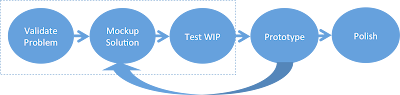
Customer Development Pipeline

Note: after the first couple interviews we lump the first three steps together.  Just be careful to ask them in order so you don't influence the user's perception of the problem with your solution.  Also, drop customers from your funnel if their needs start to diverge from the pack.  You don't need to make everyone happy - just 10.

Monday, June 17, 2013

HBS Retrospective

graduationAfter three long (stuffed startup in between the first and second) years I’ve finally graduated from HBS.  Looking back, it was an unquestionably amazing experience in all of the most unexpected ways.

I originally came to business school for three primary reasons

  • Credibility – HBS is one of the best name-brand degrees out there.
  • Financial Toolkit – I was working on a company with good exit potential and wanted to understand just how to value it (google failed me!)
  • Professional Contacts – I wanted to meet likeminded people and tap into great new professional opportunities.

As it turns out the only thing I really got from the experience that I expected was the financial toolkit.  I learned a TON about how acquisitions are valued in theory (discounted cashflow) as well as reality (market comps and asset values).  However, as an HBS grad I found I had less credibility than when I was a Microsoftie and never ended up leveraging the relationships I developed at HBS for professional reasons (less than 2% of HBS goes into entrepreneurship).

What I did leave the school with were the following:

  • Community – This was the most valuable and surprising to me.  The cohort I came to know and love in both years was truly amazing.  Not only were they the accomplished and ambitious young professionals I expected, but they were incredibly kind hearted and fun loving human beings.  I know that I’ll forever be a part of the the best social club in the world.
  • Nothing to prove – Up to this point I’d always felt like I had to prove myself to society.  Be it by garnering recognition or financial rewards – there was always another rung to climb.  HBS does provide a cloak of accomplishment (you went there?  must be doing something right) universally recognized.  Now I can settle down and do what feels right to me – not society.
  • No Fear – Getting the degree means you never have to worry about money again.  As far as I know nobody with an HBS MBA has struggled to find a job that pays enough to cover basic needs.  It’s a meal card for the rest of my life.  This frees up the rest of my time and risk appetite to do only what I love with no fear.  One of my favorite professors (Shikhar Ghosh) is fond of saying his students have around 2500 weeks to live.  Use them wisely.   

In short, I came to HBS to improve my career and they ended up setting the foundation for the rest of my life.  The last three years will easily be the most transformational in my life, and yet I couldn’t be more excited about the decades to (hopefully) come!

Sunday, April 7, 2013

How to Discover the Perfect Product Design

As an engineering my first instinct is to code first and ask questions later.  At best this results in a product I love, but nobody else cares about.  At worst, it can tie up an entire development team coding product iterations for ages.  So, how can we build the right product the first time around? 

Customer Development.

This is a completely customer centric approach to design pioneered by Steve Blank (who has built several successful companies with it himself).   The basic idea is to start by understanding the customer and then to create a product that suits their needs.  This is the opposite of many traditional companies that build products fist and then test market adoption afterwards.

The fundamental reason this works is that for many products you can test market adoption without a product. 

From my experience 80%+ of a product is in the design – and can be validated with a high fidelity mockup – which is a tenth of the cost of a prototype.  This means you’re getting 80% of the value at 10% of the price.   And, even is money is no object, it will increase you ability to iterate by 10x.

So practically speaking – how does this work?  Here is my simplified 7 step process:

1 - Start with a Thesis and a Mockup

Spent a day (or less) identifying the customer (ie salespeople) and designing the product they want (a mobile notes platform).

2-Make a List

In Excel make a list with the following columns: first name, last name, email, title, company, notes.  Then fill this sheet with as many names of potential customers as you can find.  Great sources for customers are:

  • Your personal/professional network
  • 2nd degree connections (ask your friends/colleagues if they know potential customers)
  • Alumni networks
  • Linkedin – just search around and send polite messages to relevant folks.
  • Local professional groups.  Most industries have some manner of in person meetings. Just look on google, meetups, blogs to find these.
  • Contact people via twitter/their blog/their personal/company website.

3-Send out Emails

Send the people on the list a short and polite email.  Example:

Hi Mr. Smith,

I’m working on a mobile product for sales people and found your name on Linkedin.  Your experience at ACompany looked very relevant to my project.  Do you have 15 minutes to talk in the next few days? 

Thanks,

Cy

4-Conduct Interviews

Sent a lot of those emails out.  Expect less than half to respond.  For the folks that do set up time to talk in person or over the phone have a script ready.  The conversation can flow naturally, but you want to carefully ask questions that start very broadly and then become narrower.  The goal here is to learn as much as possible about the customer without influencing their perspective with your ideas. Example:

  1. What do you do?
  2. Can you walk me through a typical day for you?
  3. How many in person meetings do you have per week on average?
  4. How do you record notes during these meetings?
  5. How do you use those notes before the next meeting?
  6. Would you use a mobile notes platform?
  7. Would you use this mobile notes platform (show your mockup)?

*Note: surveys DO NOT COUNT.  You need to have a 1:1 conversation with a customer to truly understand every aspect of his or her life possible.  Surveys presume you know all possible answers before they are offered.  You probably don’t.

5-Followup with Iterations

The greatest reward you can give these potential customer for your time is the satisfaction of seeing the impact of their ideas and feedback. Be thankful (and always send a follow-up note).  Also, keep in touch to let them know about subsequently iterations of the product and to continue getting their feedback on your designs.

6- Sell!

Eventually, through many iterations your product should get to the point where customers are excited and ready to buy.  This is the point where begin to build!  Then, when it’s all done you can sell it to a ready and eager customer base waiting to buy!

7-Groom Evangelists

The last, (but not least) step is to followup with customers using your product and improve their experiences.  If they are ecstatic about your product encourage and provide a channel for them to reach other customers (through their own social media networks, a company blog, whitepapers etc).

That’s it!  If you follow these simple seven steps you will avoid the engineer’s folly of building a great product that nobody wants!  As Steve Blank is fond of saying “Get out of the building and talk to customer!”.