Showing posts with label sales. Show all posts

Monday, May 5, 2014

How to Close Deals while Having Fun at Your Next Conference (ft. Casey Kerr)

Conferences are both the most valuable and challenging environment to make new connections.  While there are people everywhere a deft hand is required to effectively identify high potential prospects, make contact, and get the follow up meeting.  I've personally always struggled with this art, so for this post we're tapping in my good friend @caseydkerr - a prospecting guru - to show us the ropes. 

The Challenge

Imagine being by yourself. You enter a room full of tables of people you don’t know. These people are there to listen to someone else, not you. In fact, some of these people don’t want to be bothered. And you’re bothering them.

Welcome to how most people feel when attending a conference! As a sales rep or business owner, your goal is to get past any awkward feelings and find the folks there who want to buy what you’re selling, invest, or partner with your business. A friend of mine who I really admire approached me recently and asked me for guidance on how to have an effective strategy at a conference.

Having hit the conference circuit for over a year and building/training a sales development team, here are my ideas about making the most of your next conference:

Prepare for success:

  1. Exercise is great before a conference. Work out, listen to music, or go for a run. Your energy will affect others.
  2. Grab breakfast or coffee. Clear your mind. Focus. Try deep breaths, yoga, prayer, or whatever works for you.
  3. Message speakers or attendees beforehand to arrange meetings. LinkedIn is best.Be happy! Call a relative or a friend to catch up. Laugh hysterically. Feel loved. You’re about to have hundreds of conversations with strangers, so have fun!

Set goals:

  1. Your main objective should be to book meetings. Each day should a minimum quota of 3 qualified meetings with decision maker(s).
  2. Do 10% - 30% of the talking. Ask questions & learn about this person. Leverage what is said to book a meeting.
  3. Ideally, your goal is to get your prospect to take out his or her phone or laptop & create the calendar event.
  4. Set silly small goals along the way. Give 3 people a high-five. Talk to someone in line. Make 5 people laugh. Talk to 10 people in 10 minutes.  The sillier you make it, the more fun you’ll have.

Approach people:

  1. Pay a compliment & immediately ask a question. My favorite opening line is “This looks like a fun group!” followed by a question like: “where are you guys from?” or “what brought you to the conference?”
  2. Be topical. If the speaker just spoke about a particular business strategy or piece of software, ask their thoughts. If you’re at the breakfast table, ask if they usually eat pineapple for breakfast.
  3. Ask questions to qualify your prospect. For example, if you’re selling Marketo, you may ask:
    • “Do you use marketing automation currently?” [project]
    •  “What are you guys thinking of spending? Hundreds? Thousands? Tens of thousands?” [budget]
    • “Who’s typically involved in these decisions? Who signs? [decision maker]
    • “When are you thinking about buying? Tomorrow? Next month? Next year?” [time frame]
  4. Be aggressive at getting contact info! Ask for cell phone numbers. If you have a gimmick, getting a cell number is easy (see #4).
  5. Ask for the meeting! “What is the best time on Tuesday 7th, how about 10am?” or “what time works best to get Susie and Bill together next week?”
  6. Most importantly, remember to ask questions and nail down a date and time on their calendar for a meeting.

Have a gimmick:

  1. Plan an after hours party, an iPad giveaway, a helicopter tour, etc. Anything that allows you to approach someone you don’t know and ask: “Have you heard about our after hours party happening at the Yard House across the street at 6pm?”
  2. For an event, promise amazing attendees. Get (or beg) someone important to attend. Go around telling anyone and everyone that the “VP of Marketing at Facebook” or whoever is coming.
  3. Have something memorable to hand out. My favorite example is a girl that handed out blinking plastic rings at an Employee Engagement Conference and said, “let’s get engaged.” Giving a gift no matter how small induces reciprocation.

Follow-up:

  1. Send really nice, heartfelt confirming emails to everyone who scheduled a meeting. Send a reminder email 1 day prior to the meeting.
  2. For others: call, email, call, email, call, email, make more calls, send more emails, and so on. Be friendly and remind them of the conversation you shared. 
The most common mistake is talking to vendors or folks at the booths. It’s an easy conversation, but it’s a waste of your time. Find your prospects listening to the speakers, standing in line, in the lobby, eating lunch, or wandering the halls. The busier and more unapproachable the person seems, the more likely he or she is to be of importance.

In summary, have fun, ask questions, have high-energy, talk to everyone there, and book meetings on the spot. If all else fails, imagine that these people have bags of cash waiting for you to talk to them. After all, that’s kinda true. :)

About Casey

Casey’s efforts helped grow Findly.com over 900% and revolutionize social/mobile recruiting technology. Starting as first salesperson, Casey personally closed over $1.5 M in Enterprise sales while managing 3 teams, including inside sales, lead generation, sale operations (10+ members).

Casey loves Bay Area tech companies and playing ping-pong, racquetball, and tennis. Casey currently leads sales efforts at Vessel.io, a Sequoia-backed mobile app tech company that helps mCommerce and social apps with monetization and optimization.


Follow him @caseydkerr or visit his LinkedIn profile.

Thursday, April 3, 2014

Cold Calling and Email Scripts for Startups

Sales4Startups has long been the best sales event in the Bay Area.  Even as a guy who’s been selling for years now I learn more about the unique art of selling at a startup at every event.  The highlight of this evening was hearing from Steli Efti of Close.io.  Stei is a sales pro who’s been hustling since his days at YC.

How to Use Cold Calling To Sell (yes with a phone!) 

This has long been something I’m skeptical of, but Steli did a great job of framing when it was useful.  Since it takes time from a real person and has a very low hit rate (single digit %), it needs to be for larger accounts and use as a way to reach decision makers (in his case founders/CEOs).  His process was as follows:
  1. Reach people – shoot for 10-15% reach rate (ie valid numbers) or you need to fix your prospecting source.
  2. Sound good – sound excited.  You don’t have body language  - you just have voice. 
  3. Ask questions – qualify them. Figure out if your solution is for them.
  4. Manage objections – prepare!  You’ll get the same question many times.  Don’t ramble.  Answer in a concise way – 1-2 sentences
  5. Close- have a call to action.

The original prospecting list for Elastic Sales came from CrunchBase (go to where your customers are) and qualified as B2B startups who have raised a series A (aka have money and are scaling).  Then they’d jump online to find a number to call. 


Cold Calling Script

Steli was also kind enough to share his script (commentary added in brackets):

Hi my name is I’m calling some startups in the area to find out if they are a good fit for you beta program [qualifying industry lingo]

What do we do in a sentence [relax I’m not going to talk for an hour] we provide companies with a sales team on demand [MVP pitch]

Does this sound generally interesting to you [doesn’t matter what they say now – they were thinking something – but they don’t have enough data to say yes or no]

[let them verbalize it]
[is there potential or isn’t there potential]
[now start qualifying]

What is your current sales process?
Who are your customers how do you get leads?
What’s the customer’s lifetime value?

[test close - try and set the parameters for the deal and the next steps for closing]
We want to start in 3 weeks does this work for you
The beta program is heavily discounted it’s going to be $x per day per sales person
We can only offer you 1 salesperson to begin with  (that’s going to be me)
What is the decision making process in your company? [what are all the steps it takes for us to get this done?  This is the most important question]
How quickly can we make a decision

>>Schedule closing call.


Q & A from the Audience on Cold Calling

Q: Should I leave voicemails?
A: If you cold call people multiple times then don’t leave a VM – it can take away your permission to keep calling.  Just keep calling.  If you’re not calling back it won’t hurt. 

Q: What if they say it's a bad time?
A: Say: Is this a bad time?  Can I get your email? This often lowers the guard of a prospect so you can continue the conversation (ask about the process at their company).  Let them continue talking as long as they want (do not keep them on the phone by talking yourself).

Q: What if someone is not at all engaging with you? 
A: Establishing trust – call out the elephant in the room.  Look man – I know you don’t know me, but here’s who I am and what I want to do.  Let’s see if I can build some credibility.


How to Use Emails to Sell

The big point Steli hammered home on email sales was to focus on making them sound personal.  Just like we say at Contastic - people are sick of spam - email needs to be personal and relevant.  Here's his process:
  1. Open – 80% on subject line 20% on the body.  Make it look like it was sent by a person.  More like "Hey - here's a product I thought you should see" and less like "Ten tips to better sales".
  2. Read – every sentence is a pitch to read on.  Here’s’ who I am, here’s what I do.  Add credibility (customers, investors, press, background).   What’s the next step/call to action? ONE call to action. 
  3. Respond - This is a good time to set up a call/initial meeting.
  4. Follow up - Stay in touch.  People often forget emails and you should never be the one to let a thread die. 

Q & A from the Audience on Email Sales

Q: Is Text better than HTML?
A: Text is always better than HTML.  You want this to look personal - like it was sent between family or friends.  No humans send HTML formatted emails with logos to each other.  That's a signal it's a sales email.

Sunday, December 22, 2013

How to Validate Your Product Idea


The default answer is yes.  Ask anyone about your idea - that's what most will say. Yes is free.  Yes may even earn them some brownie points.  Yes is easy.  Yes is worthless and not to be trusted.

No is expensive.  It risks insulting someone’s life’s work and ruining a relationship.  Very few will invest a No in you when they can cash in a Yes.

So, how do you figure out if your idea is a good one - and worth building?  These are the three steps we use at Contastic to make users invest with us – this is the real meaningful yes:

Emails (Attention) 

The first step to validating any venture is the landing page.  Mock it up to look exactly like it will after you product is launched.  However instead of a payment form you’ll have a signup form for people to ‘pay’ with their emails.  This is giving you permission to message them about you product.  It signals that they have a problem and your product at least looks like their solution.  Also, when you do launch, you’ll have a set of beta users ready to go. Shoot for 100 – it’s a nice round number that generally extends beyond your close circle of friends.  This is an investment of their attention.

Users (Time)

After gathering an email list of interested users create a quick and dirty prototype. This should be the bare minimum where it is useful to users.  Note that this does not at all mean easy to use, polished, or pretty.  As soon as it can add value in anyway to your users – launch it to your list.  Then, watch to see if people use it regularly.  You can learn a ton about how people are using it, and their regular engagement will be a sign that you’ve hit the mark.  They are now investing their time.

Customer (Cash)

Cash is king – and in this exercise it’s no different.  There is nothing harder than getting a customer to open up their wallet and part with some hard earned cash.  Use the existing landing page from step 1 and convert the email collection to a payment form.  Now that you’ll getting some dollars in the door – congratulations – your idea is now validated!

To be sure, this is not where the validation ends, the Customer Development Process leverages a similarly progressive framework to validate all areas of your business form acquisition to retention.  If you have any other tips and tricks for validating your product ideas let me know in the comments below.

Wednesday, November 20, 2013

Salesforce in a Nuthsell from Dreamforce 2013

Having just spent the day at Dreamforce I was struck by the incredible breadth of the offerings at Salesforce.  And, for the life of me I couldn’t find a single document to help me keep them straight.  So, with some help form @halesalesforce (thanks Will!) I’ve built out this quick and dirty diagram for those of you still at Dreamforce to navigate all of the new offerings:
The major theme of the company this year is integration.  In the past Salesforce has focused on storage in the Cloud.  Now they have the data, and need to integrate it into a cohesive system.  Every customer I talked to underlined this as the primary pain and the vast majority of partners at the Dreamforce expo were focused on this.  So, it seems this is the era of integration.

This begs to question – what’s next?  My money is on intelligence.  Once we have all of an organization’s data in one place – we can now (finally!) analyze it.  Sales needs to become smarter by harnessing machine learning, statistic, and NLP to translate the tribal knowledge of top salespeople to an entire organization.   Imagine a world where every sales rep can follow best practices powered by data. I’m looking forward to seeing some smart sales solutions at Dreamforce 2014!

Monday, February 25, 2013

No Business Card Challenge

I have a confession to make: I don’t have business cards.  I used to carry them religiously – 3-4 in my wallet at all times – ready with a card for a serendipitous connection.  I’ve given and received hundreds of cards over the years, but can still count on my fingers the number of valuable connections made. Following up ‘later’ just never happens.

image

When I meet someone interesting today – I simply send them an email on the spot. It takes just a second - type in the email address, fill in the subject and you both have a cue to connect sitting in your inboxes instantly.  This removes the separate task of follow up after an event, ensures that the message isn’t lost in a jacket pocket for eternity, and provides an immediate cue to connect later. 

In a time before iPhones and 4G business cards had a place as the most efficient means of exchanging information.  However, today, when we all carry our computers in our pockets they  just don’t make sense and should be relegated to being a lost vestige of the meeting ritual:

So I ask of all of you to shelve the archaic cardstock artifacts of last generation’s business world and join the mobile generation. Make connections instant and persistent.

Take the No Business Card Challenge!

And now that you have a bunch of business cards you won’t be handing out anymore – Hugh MacLeod has found that they make the perfect cartoon canvases:

Friday, February 15, 2013

Learning to Talk

Remember doing that a few decades ago?  Well, as it turns out the fun never ends!  In person communication is the most powerful form of persuasion.  As an entrepreneur – especially as a founder – your voice is the most important asset you bring to a company.  We can always hire for skills.  However, that person who’s passion can power a team or persuade an investor becomes the irreplaceable piece of a company’s DNA. That’s a key difference between a founder and an employee.

Since speaking comes naturally we often will gloss over the practice of this art with a good enough subsistence level of skill.  What an opportunity to miss.  Like any other skill, through deliberate practice the level of competency will grow.  In this vein HBS brought in KNP Consulting to study some videos of past presentations.  Here’s the one I chose:

I was lucky enough to sit down with Matt Kohut who has some pretty incredibly experience training speakers – especially in the engineering space (NASA no less).  Here’s the core lessons he had for me based on the clip:

  • Slow Down! Not news to anyone that knows me – but I talk FAST.  This makes the message hard to digest and understand. 
  • Cadence is a roadmap.  Modulating the pace and tone of speech provides an audience with subtle cues for the importance attached to each part of the speech.  When you get to the most important point – lower your voice, slow down your delivery, and then stop.  A pause is the most powerful form of punctuation.
  • Move deliberately.  When walking around a stage – it’s important to pick a point or a person and walk towards them.  Deliver a message as you walk.  Finish the point and walk away.
  • Play with balls.  Most motions on stage should mimic holding a sphere ranging in size from a basketball to a bb.  The deliberate movements conforming to a round shape creates a strong movement with an organic (warm) pattern.
  • Reading recommendations:
  • imageStrong vs. Warm.  The core analytical tool they use to think about a speaker’s effectiveness is how strong or warm you are perceived as.  It’s important to note that people prefer warmth to strength (just in case you’re picking one).  Figure out what your baseline place on the spectrum is and then carefully pick the appropriate place on the spectrum for each situation (talking with your team vs. talking with a VC). 


I love the framework and deliberately choosing the mix of strength and warmth that you need to project in any given situation.  The real challenge to continually developing this skill is collecting feedback.  Self-monitoring is extremely difficult since it distracts you from the conversation and will inherently make you less effective. 

The best way I’ve found (both personally and with my clients) is to designate a spotter – an ally in important presentations and meetings who can focus on watching you to provide feedback afterwards.  Any ‘bad behaviors’ go on a list for the spotter to flag in conversation for me (think of it as an early warning system).  The notes from KNP will definitely go on mine!

Thursday, January 31, 2013

Book Report: Click

image

Ever wonders what makes people click?  Brothers Ori and Rom Brafman tackle this timeless question (well!) in their new book Click.

They cite five primary factors that make people ‘click’:

  1. Vulnerability.  While certainly not a risk-free activity, sharing a personal vulnerability is an immediate way to appear authentic (you are placing truth over pride) and confer trust.
  2. Proximity.  Most relationships (personal or professional) are dictated by distance.  Be where the people you want to meet are.
  3. Resonance.  Sympathize with your audience and communicate your authentic understanding of them and their situation.
  4. Similarity.  The shocker here was volume trumps quality.  People are more likely to perceive more closeness with another that shares a number of trivial similarities (same hometown, birthday, favorite ice cream) than a singe large one (career choice).  While counter-intuitive to me, I can understand how the discovery of each new (even trivial) similarities is a cue that re-enforces your bond each time it occurs.
  5. Safe Place. This can be determined by frame (we are the most similar people in this room) or by a common adversary (we’re in it together!).

So if most of these factors are pre-determined what is one to do to improve the situation?  Of the many ideas outlined my takeaways were:

  • Personal Elevation.  The vast majority of people have a complimentary person.  Be it personal or professional, there are people out there that make you more than the sum of your parts.  Find them.
  • Modulate expression.  The ability to match your expression to the common level of the group demonstrates a strong awareness and creates comfort (see similarity).
  • Be the Hub.  Helping people meet is the most powerful way to meet others yourself.  There are always those that are at the center of communications.  If nothing else, identify the hubs in your life!

While I approach many of these pop-psychology books with a healthy does (or two) of skepticism, Click really delivered on some intuitive observations followed by quite a few actionable recommendations.

All the factors that make you Click are current.  It will align your present selves, but not your future goals. I think of the aspects of Click as an emotional fit (heart) – don’t forget about the intellectual fit (head)!

Tuesday, January 22, 2013

i-Lab Silicon Valley Trip in Review

After a long 10 days on the move and a redeye return flight I’ve just started to catch up on sleep from the whirlwind tour of Silicon Valley.  First, I wanted to include a couple pictures that didn’t make it past twitter from IDEO:

Our seminar in design thinking from the best:

We ended up building a prototype for screens that would play cute/funny videos in airports.  Stressed out waiting at the gate for a delayed flight?  Look at the puppies and feel your blood pressure drop!

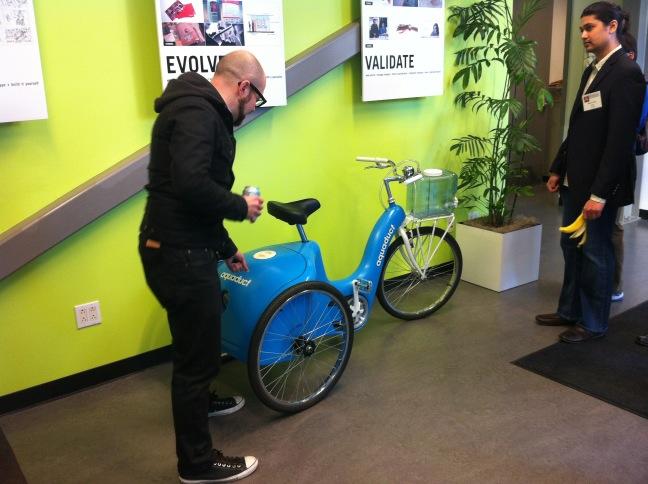
One of many amazing prototypes kicking around the IDEO offices (a bike that pumps water as you pedal!):

And, to put a bow on the trip I took some time to consider and consolidate all of the advice, stories, and experiences that were shared by the great folks who took their time to speak with us.

  • There has never been a better time to start a business. There’s a lot of money out there.  VC/customer standards are getting higher – only because the barriers to entry (building/distribution) are getting lower.  All in all life is getting easier for entrepreneurs.
  • It’s all about execution and traction – not ideas.  Ideas aren’t worth signing an NDA.  VC’s probably can’t think like your customers.  Everyone relies on evidence.  Build only to elicit customer feedback or observe customer behavior.  That should be the driving mantra for everything you do.  This is MVP.
  • Be intellectually honest.  The biggest failures I saw came from great sales.  They sold themselves and they sold others on a powerful idea.  The rest of the startup exercise was simply confirming the bias.  Beware of this tendency (especially if you’re are a natural seller).  Use great scientific practice to find a great idea with proven promise.  THEN sell the living daylights out of it!
  • Think BIG.  VCs want markets in the $1B range.  Every VC has a sweet spot between ridiculous ($1 Trillion) and to small ($50 Million).  It’s hard to say what the limits are but everyone liked business with single digit billion dollar potential.
  • Expect to have an early prototype with strong traction, a great team, and a huge market before looking for VC.  Angels may only need one of the three to invest.
  • Keep in touch.  Just like entrepreneurship is a career – not a shot in the dark – everyone you meet in the startup ecosystem is a colleague.  Approach everyone from VCs to founders to customers with the knowledge that you’ll see them (especially if they are great) again and again.  You’ll develop a relationship over a lifetime – even if they didn’t fund you, work with you, or buy from you.  A “no” just means “not yet”.

And, in case you missed my cross-post here’s the post I did for the i-lab blog: What Investors Want with a Twist of d.school.

Monday, January 14, 2013

Super Simple Scrum

In my last post I discussed my process for task allocation using a calendaring system (ie Outlook). However, in order to do this successfully you need to be equipped to successfully estimate the amount of time a task require. In the engineering field there are countless methodologies to aid in this effort for developers, but my favorite is Scrum.

One of the core elements of Scrum is the calculation of a ‘load factor’. Before doing a task you estimate how much time you think it will take. After the task is completed you record how long it took you.

Load Factor = (Reality-Estimation)/Estimation

image

Initially this number will have incredibly high variance, but over time, your load factor will start to stabilize. This will enable you to revise any of your initial estimates. For example, My load factor is currently around 1.5. This means I’m consistently overambitious and underestimate the time required for a given task by 150%. So, next time I try to estimate a project – I’ll do my standard estimate and then just multiply it by 1.5.

Ideally, your load factor will fall over time as you become more aware of your personal bias and begin to adjust. However, many people (myself included) – especially those with large variation in task types (in a day I’ll do anything from coding to design to door to door sales) may never get to a low load number.

Luckily, the load factor has you covered. It’s a great tool to reduce the uncertainty of planning from the inaccuracy of your guess (one project) to the volatility of your load factor (over several projects). While I initially started using this system to estimate consulting work (where cost overruns are a serious client issue), it has proven so useful I apply it to every aspect of my life.