Showing posts with label entrepreneurship. Show all posts

Wednesday, November 13, 2013

The Case for Being Pig Headed

One of my dad's favorite analogies comes from breakfast.  In the classic plate of bacon and eggs the chicken is involved, but the pig is committed.


When applied to entrepreneurship I think about the interplay between investors and entrepreneurs.  Investors have money at stake - usually in the single digit percentages of their net equity.  Entrepreneurs on the other hand are betting it all - all of their time, all of their energy, and often all of their money.

So, I've always been surprised that entrepreneurs evaluate the viability of their company by the input they receive from investors.  The chickens, often with comparatively little at stake, evaluate opportunities and give advice from the perspective of the involved...not the committed.

Entrepreneurs should instead focus on themselves - the committed. Are you all in?  Does every piece of evidence point to this venture being worth the next 1-2 years of your life?  Are customers willing to bet the farm on you?

Be brave.  Be pig-headed.  And stop listening to those chickens.

Wednesday, November 6, 2013

Rethinking Customer Development

I'm a huge fan of Steve Blank his theory of Customer Development.  I've found his writing always inspirational and insightful.  However, has been a little to dense for me to use as a clear roadmap.  Many in the Lean Startup movement point to the Business Model Canvas as a cure - which, try as I might, I've never been able to actually follow in a real live business.

The issue was that each of these pieces is part of a flow - not a discrete map.  So, here at Contastic we started using a variant that models the business as a process rather than as a map:


This covers same essential areas as the Business Model, but slightly re-arranged to fit the process of validating a startup.  Generally, each stage from left-to-right is dependent on the next and should be evaluated in that order.  At each milestone the company should seek to find a path through.  I like to have at least two stages written out to look at: general themes, and then specific actions/sources to test:


While by no means complete, this model serves as a basic roadmap of our plan.  We also often use  third level for tactical tests to confirm items in level 2 (ie acquire 20 customer per day at Dreamforce).  As they are confirmed the fact bubbles up to the next level.  As we develop the company we continually edit this knowing that the dependencies flow from left to right and then top to bottom.  

Hope this helps you all bring a strong evidence-based approach to your ventures.  We're continually evolving this model, so if you have any ideas for improvements or cases where it fails let me know in the comments below!

Sunday, November 3, 2013

Seven Deadly Startup Sins

I've been working full time on Contastic (getcontastic.com) for about three months now fully immersed in the valley culture.  It's amazing to be in a place with so many resources, but each opportunity is also a distraction.  Time is your most precious commodity - if it's not invested wisely, your company will die.  In the spirit of helping founders make better choices here are the seven deadly startup sins to avoid:

1 - Building too many things

It's hard enough to build one feature well.  If you attempt anything more than that you will dilute your resources and will end up with a basket of mediocre features that nobody cares about.  Approach scoping from the prospective of a 10 second demo - only build what can be demoed in 10 seconds or less.  This is all the time you'll get from a customer or investor.  Spend your time making one amazing magical feature that can wow anyone in 10 seconds.

2 - Getting feedback from non-customers

The first thing people do when building a company is to ask the people around them.  This is lazy and leads to bad information that will lead you down the wrong path.  Focus on customers - people willing to pay for your product at some point.  Ignore all other input.

3 - Building features customers won't pay for

When I started using lean methodologies I quickly found myself drowning in divergent customer feedback.  When asked 'what would you use?', customers will ask for everything under the sun.   The real question is 'what would make you pay (more) for this product'?  If adding a feature doesn't change their willingness to pay drop it.   Only build what changes willingness to pay for a large segment of your customers.

4 - Following advice

Almost all advice is well intentioned, but bad.  Nobody knows your business like you do.  Ask people for their stories, their experience, and their opinion within their scope of expertise.  Do not ask for or listen to anything else.  The worst advice comes from experts outside their field of expertise.  It sounds deceptively credible, but will lead you down the wrong path.

5 - Telling customers what they need

Coming from a sales background I'm naturally inclined to get to 'yes'.  While good sales, this drive is a terrible way to gather data.  When interviewing customers adopt the socratic method - ask questions and avoid making any declarative statements all together.

6 - Not asking for the introduction

Every good conversation you have should send with an ask for introductions to others.  At any stage if you have one person that likes you, your idea, or your product, use them to find similarly minded people.  Birds of a feather flock together, so one fan can usually lead you to more.

7 - Not having a plan

Engineers are often guilty of the 'build first ask questions later' mentality.  Building is the most expensive way to validate an idea.  Create a step-by-step plan which ends with coding - require a high barrier of proof before building anything other than mockups.  We use the rule of 10 - 10 customers must say yes before we move on.  In this model we'll talk to at least 30 customers before coding.  Here's what we follow:
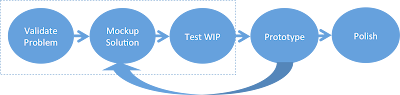
Customer Development Pipeline

Note: after the first couple interviews we lump the first three steps together.  Just be careful to ask them in order so you don't influence the user's perception of the problem with your solution.  Also, drop customers from your funnel if their needs start to diverge from the pack.  You don't need to make everyone happy - just 10.

Sunday, April 7, 2013

How to Discover the Perfect Product Design

As an engineering my first instinct is to code first and ask questions later.  At best this results in a product I love, but nobody else cares about.  At worst, it can tie up an entire development team coding product iterations for ages.  So, how can we build the right product the first time around? 

Customer Development.

This is a completely customer centric approach to design pioneered by Steve Blank (who has built several successful companies with it himself).   The basic idea is to start by understanding the customer and then to create a product that suits their needs.  This is the opposite of many traditional companies that build products fist and then test market adoption afterwards.

The fundamental reason this works is that for many products you can test market adoption without a product. 

From my experience 80%+ of a product is in the design – and can be validated with a high fidelity mockup – which is a tenth of the cost of a prototype.  This means you’re getting 80% of the value at 10% of the price.   And, even is money is no object, it will increase you ability to iterate by 10x.

So practically speaking – how does this work?  Here is my simplified 7 step process:

1 - Start with a Thesis and a Mockup

Spent a day (or less) identifying the customer (ie salespeople) and designing the product they want (a mobile notes platform).

2-Make a List

In Excel make a list with the following columns: first name, last name, email, title, company, notes.  Then fill this sheet with as many names of potential customers as you can find.  Great sources for customers are:

  • Your personal/professional network
  • 2nd degree connections (ask your friends/colleagues if they know potential customers)
  • Alumni networks
  • Linkedin – just search around and send polite messages to relevant folks.
  • Local professional groups.  Most industries have some manner of in person meetings. Just look on google, meetups, blogs to find these.
  • Contact people via twitter/their blog/their personal/company website.

3-Send out Emails

Send the people on the list a short and polite email.  Example:

Hi Mr. Smith,

I’m working on a mobile product for sales people and found your name on Linkedin.  Your experience at ACompany looked very relevant to my project.  Do you have 15 minutes to talk in the next few days? 

Thanks,

Cy

4-Conduct Interviews

Sent a lot of those emails out.  Expect less than half to respond.  For the folks that do set up time to talk in person or over the phone have a script ready.  The conversation can flow naturally, but you want to carefully ask questions that start very broadly and then become narrower.  The goal here is to learn as much as possible about the customer without influencing their perspective with your ideas. Example:

  1. What do you do?
  2. Can you walk me through a typical day for you?
  3. How many in person meetings do you have per week on average?
  4. How do you record notes during these meetings?
  5. How do you use those notes before the next meeting?
  6. Would you use a mobile notes platform?
  7. Would you use this mobile notes platform (show your mockup)?

*Note: surveys DO NOT COUNT.  You need to have a 1:1 conversation with a customer to truly understand every aspect of his or her life possible.  Surveys presume you know all possible answers before they are offered.  You probably don’t.

5-Followup with Iterations

The greatest reward you can give these potential customer for your time is the satisfaction of seeing the impact of their ideas and feedback. Be thankful (and always send a follow-up note).  Also, keep in touch to let them know about subsequently iterations of the product and to continue getting their feedback on your designs.

6- Sell!

Eventually, through many iterations your product should get to the point where customers are excited and ready to buy.  This is the point where begin to build!  Then, when it’s all done you can sell it to a ready and eager customer base waiting to buy!

7-Groom Evangelists

The last, (but not least) step is to followup with customers using your product and improve their experiences.  If they are ecstatic about your product encourage and provide a channel for them to reach other customers (through their own social media networks, a company blog, whitepapers etc).

That’s it!  If you follow these simple seven steps you will avoid the engineer’s folly of building a great product that nobody wants!  As Steve Blank is fond of saying “Get out of the building and talk to customer!”.

Wednesday, March 27, 2013

Finding Founders Post @ HIPPO Reads

image


There’s a new Hippo on the block in high quality content.  After being introduced to Hippo Reads by founder Anna Redmond I’ve really enjoyed learning through their curated content. 

In each ‘curation’ an industry expert leads you through a rich array of secondary content in an essay format.  With topics ranging from Healthcare to Justice the breadth of content and voice of the curators make Hippo Reads a great digital escape where readers can explore a new topic in just a few minutes.

If you want to read more check out their most recent piece on Entrepreneurship (by yours truly): Finding Founders.

Saturday, February 9, 2013

Trend Report: Chi-Hua Chien from KPCB

On my usual perusal of TechCrunch I found an unusually straightforward set of insights from an Ask A VC Interview with Kleiner Perkins’ Chi-Hua Chien.   Some key takeaways:
  • Mobile first.  While they make life easier for consumers the real shift is what the enable on the supply side.  If you look at companies like Uber, Cherry, and Zaarly – they require that suppliers have mobile POS systems (iphones) that are able to take orders and manage payments for any vendor that is constantly on the move.
  • Realtime reporting. Companies like Charity: Water have taken advantage of plummeting hardware costs and improved telecom technology to provide an unprecedented level of realtime reporting.  In the case of Charity: Water  they’ve used this to provide a new level of accontability to their charity operations – so a consumer can understand exactly how much water their specific well is providing – the most concrete measure of impact for your donation.
  • Favoring enterprise over consumer.  This is a new trend driven by the fall of the frothy consumer financing market.  Just forget it. The top consumers companies (Facebook, LinkedIn, Twitter) were founded in the dark days of the web (‘04-‘06) when people were fearful from the post ‘00 bust or the explosion of Google.
His closing thought (and my key takeaway):

“If you have a vision, passion, and a very clear problem as an entrepreneur don’t worry about what ventures investors are funding or not funding.  go build a great product in a great market and you’ll get funded.”


Tuesday, January 29, 2013

Whaling Venture Capital

In the new semester I’m enrolled in a course on the history of Venture Capital with Felda Hardymon and Tom Nicholas.  The fist case traced the history of the industry back to the swashbuckling day of hunting whales for oil (sorry PETA).

image

At that time there were three parties involved (aside from the whales):

  • Investors – wealthy individuals (doctors, lawyers, merchants) looking for investments more exciting than banks and mortgages can offer.
  • Captains (entrepreneurs) – they ran the ships and were the operational engine behind the venture.
  • Agents (VC) – the folks that coordinated captains and capital to get expeditions funded and underway.

Sound familiar?  This system, pioneered with the advent of new money (folks who can finance ventures that aren’t kings) required a new kind of coordinator who could aggregate capital and link it to strong capital.  Enter the Agent (aka VC). 

This model is a very high fidelity echo of the world we work in today.  Everything from the risk distribution (your ship sinks/you catch a whale) to the distribution of returns (the few most successful enterprises reaped the vast majority of rewards).

What’s fascinating is how economically impactful this model was.  Of the 900 whaling ships at the peak of this industry (which could bring in almost $100M 700 were American.  Why?  America was the country that truly embraced the Venture Capital Model.  To this day, Venture Capital is by far the most effective way to translate capital into job growth.

The hall marks of the VC asset class are:

Persistence.  This means a successful firm will likely continue to be successful.  Making investments in companies is very difficult to externally verify.  A huge amount of trust and instinct goes into the decision making process on all sides.  Subsequently, personal relationships are at the core of this industry.  As you are successful and grow – so do your relationships.  This also exists in Private Equity – making VC/PE the most persistent investment classes (by far!).

Cyclicality.  Whaling, like startups, follows a boom and bust cycles.  Either you catch the great white whale or you don’t.  Boom or Bust.  The returns on these investments (adjusted for risk) far outweigh those of any other class.  However, investors need to be able to whether the storms (aka losing all your money).

If nothing else we can all feel a little more rugged and seaworthy – as we are the whaling captains of modern day.  Just avoid being Ahab!

Tuesday, January 22, 2013

David Teten of ff Venture Capital on White Space

Today David Teten came up from New York to share his years of entrepreneurial and investment experience with the Harvard GASA Business Club.  In addition to being a Partner with ff Venture Capital he is the Founder and Chairman of the HBS Angels of Greater New York. 

The talk was split into two major parts: picking a company and then making one successful (eg sales techniques).  David’s primary recommendation – which was re-emphasized throughout his presentation – was to pick a market with few competitors.  He noted that even great markets can lead to depressed returns due to overcrowding.  He also introduced a couple Market Maps which serve as a good guide to identify holes:

image

While the second half of his talk was designed to aid in conducting research on your new idea, all of the techniques were very useful tactical recommendations that will serve an entrepreneur throughout the life of a venture:

  • Search Google for specific file types (pdf/ppt/doc) to find some great presentations/material on your competitors
  • You can get access to a lot of great research through a Charles Schwab Account
  • Use trackers (ie compete.com) to keep a finger on the pulse of your competitors.
  • Conduct polling – adwords, google docs, survey monkey, and now google consumer surveys!
  • Use a combination of affinity, information, other's’ credibility, and ego boosting to get people to return your calls.

Also, as a closing note David’s site (http://www.teten.com/) has an amazing wealth of great content.  I particularly loved the section for CEOs/Founders.  And, he was kind enough to include a video of this presentation and slides online.  Thanks!


i-Lab Silicon Valley Trip in Review

After a long 10 days on the move and a redeye return flight I’ve just started to catch up on sleep from the whirlwind tour of Silicon Valley.  First, I wanted to include a couple pictures that didn’t make it past twitter from IDEO:

Our seminar in design thinking from the best:

We ended up building a prototype for screens that would play cute/funny videos in airports.  Stressed out waiting at the gate for a delayed flight?  Look at the puppies and feel your blood pressure drop!

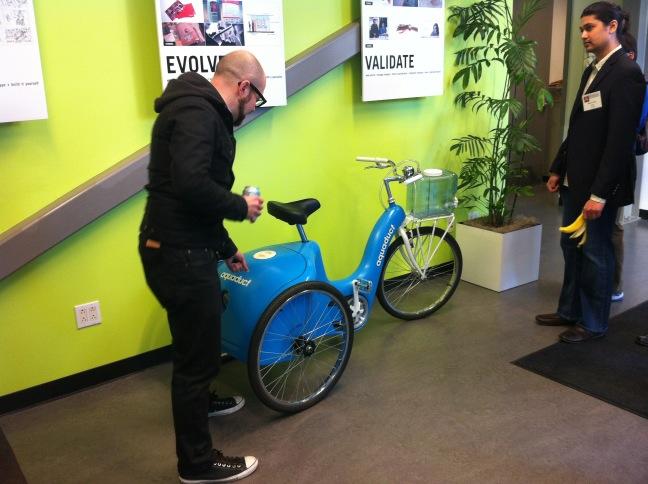
One of many amazing prototypes kicking around the IDEO offices (a bike that pumps water as you pedal!):

And, to put a bow on the trip I took some time to consider and consolidate all of the advice, stories, and experiences that were shared by the great folks who took their time to speak with us.

  • There has never been a better time to start a business. There’s a lot of money out there.  VC/customer standards are getting higher – only because the barriers to entry (building/distribution) are getting lower.  All in all life is getting easier for entrepreneurs.
  • It’s all about execution and traction – not ideas.  Ideas aren’t worth signing an NDA.  VC’s probably can’t think like your customers.  Everyone relies on evidence.  Build only to elicit customer feedback or observe customer behavior.  That should be the driving mantra for everything you do.  This is MVP.
  • Be intellectually honest.  The biggest failures I saw came from great sales.  They sold themselves and they sold others on a powerful idea.  The rest of the startup exercise was simply confirming the bias.  Beware of this tendency (especially if you’re are a natural seller).  Use great scientific practice to find a great idea with proven promise.  THEN sell the living daylights out of it!
  • Think BIG.  VCs want markets in the $1B range.  Every VC has a sweet spot between ridiculous ($1 Trillion) and to small ($50 Million).  It’s hard to say what the limits are but everyone liked business with single digit billion dollar potential.
  • Expect to have an early prototype with strong traction, a great team, and a huge market before looking for VC.  Angels may only need one of the three to invest.
  • Keep in touch.  Just like entrepreneurship is a career – not a shot in the dark – everyone you meet in the startup ecosystem is a colleague.  Approach everyone from VCs to founders to customers with the knowledge that you’ll see them (especially if they are great) again and again.  You’ll develop a relationship over a lifetime – even if they didn’t fund you, work with you, or buy from you.  A “no” just means “not yet”.

And, in case you missed my cross-post here’s the post I did for the i-lab blog: What Investors Want with a Twist of d.school.

Saturday, January 19, 2013

Swing for the fences

Randy%20_%20compThe closing speaker for the i-Lab’s Silicon Valley trek was Randy Komisar of KCPB. In addition to being a general partner, Randy is the author of the Monk and the Riddle and lead investment partner for Nest. 

With such a long history in the Valley Randy was the perfect person to provide a longsighted perspective to put our whirlwind tour into perspective.  Here are some of my takeaways from his talk and Q&A session:

  • Execution is underplayed in TechCrunch, but is the key differentiation between success and failure.
  • It’s all about timing.  The tablet wasn’t revolutionary.  It was just launched at a time when the parts became cheap enough to support a broadly appealing price point.  Steve job’s genius was in timing – he struck at the right time again and again.  Also, he was never ahead of his time.
  • No great company has been started in Silicon Valley as a lean startup.   For nest they know they’d have to invest $100M.  Have a big ethereal vision attached to a small solid grain of traction.
  • VCs are a herd.  Wallstreet is at the head of the herd.  Everyone else is trying to funnel in and get into the front of the pack to be the first in line for an IPO or M&A deal.
  • Only 25 VC firms make money.  The rest don’t.
  • It’s more likely for you to be replace as CEO of a successful company than a unsuccessful one.  As a great business scales an entrepreneurial skillset is less valuable at the helm.  If a business is still struggling to find it’s footing – the original entrepreneur is the person you want at the head.
  • Entrepreneurs rarely understand the competitive landscape as well as they should.  Understand the past, present and future landscapes.  Learn why your idea may have failed in past ventures.
  • Entrepreneurs generally don’t have a good idea of what’s going on around them.  Avoid tunnel vision.
  • Don’t leap to the final vision.  Nest is building an internet of things.  But they’re going to start by building a revolutionary thermostat.
  • Read Getting to Plan B.  Randy mentioned this book several times as a great framework for thinking about startups.
  • Entrepreneurship is important because it challenges the status quo.  It’s about questioning everything that doesn’t work around you every day. 
  • Attack a problem with your passion (work on a problem you care about).  If you divorce the two you’re at the squeaky end of entrepreneurship.
  • Entrepreneurs are fueled by a passion to change things for the better.  They believe they see something nobody else does.  And they want to make this vision a reality.
  • To find a great idea – take stock of the things you care about and then search for opportunities within those areas that match your capabilities.
  • Look for the smartest highest integrity people possible to get the best downstream opportunity set.
  • Young people shouldn’t try and start companies.  95% of them will end up with nothing to show for it in 10 years.

With that sobering closing remark (which I personally disagree with!) our Valley experience concluded.  I couldn’t have asked for a more well rounded vision of the bleak challenges and incredible promise that come with becoming a career entrepreneur.

Friday, January 18, 2013

What World Will You Enable?

To end our last day of VC visits in the Valley we spent the afternoon with Adam Nash.  Adam is a true Silicon Valley veteran who has led product for some of the top companies including LinkedIn, Ebay, and Apple. 

He was most recently an EIR at Greylock, and has recently joined WealthFront – a company dedicated to democratizing access to the financial instruments currently available to high net worth individuals.

It was a unique opportunity to talk with such a thoughtful and experienced person at a time of transition.  During the course of our conversation Adam honed in on the reason for joining WealthFront.  He said that if he didn’t join the team their vision of the future – one he was deeply passionate about – may not come true. 

This criteria resonated completely with me and will be carried forward as the new lens of legacy to evaluate my ventures moving forward.  Whether founding or joining a startup – being a part of an early team requires a complete investment of your energy, time, and reputation.  And – it often will last far longer than one would expect.

Most entrepreneurs are inclined to act.  They want to jump in and get stuff done.  In almost any business this is a great attribute.  However, in the quiet time, the time before the business has been chosen or formed – we all need to take the time to make sure we choose a path that we’ll be happy walking for the next decade. 

I’m very happy that BuildAFlock meets that criteria for me.  If we can create a world – where in the next decade – I can get up and go to a great dinner party any night of the week – I would be ecstatic.  I know I’d be having more fun, and I know this would create the closer communities we all crave.

So let this be the premier test for what is worth making the all-in investment of your entrepreneurial energy:

Will you be a critical member of a team that is making a vision of the future that you are passionate about reality?

Sunday, January 6, 2013

Book Report: Rework

I’ve long been a fan of the 37 Signals folks.  They really are the heralds of the lean movement.  The build super simple tools to run small companies and they do it using the best practices in the lean movement.  So, I was excited to dig into their book: Rework – a compendium of their best practices.

The book is organized in to 87 lessons that read like blog posts (just a few pages a piece).  Here are my seven favorites:

1- Scratch your own itch – build a product you will use.  Customer research becomes easy and part of your company DNA when you are the customer.

2- Interruption is the enemy of productivity – whether meetings, calls, emails, or colleagues stopping by – these little interruptions make sure nothing actually gets done.  I’m a big fan of arranging my work/communication in blocks. I will code or write for 3-4 hours with my phone off and outlook closed.  It’s good practice to carve out this time for your company on a regular (ie daily) basis.

3 - Go to sleep.  While everyone differs, my world revolves around sleep. Sleeping less makes me stupid and careless – often to the extend that I’m only creating more work for myself down the road.  Sure there are times where you need to pull an all nighter, but usually those events are preventable.  If you’re up all night – you’re doing it wrong.

4 - Welcome obscurity.  I think many misinterpret the lean startup methodologies to mean that you need to launch and build a product asap.  This often leads to a team maintaining the wrong business.  Lay out your theses and do the least amount of work possible to validate them in obscurity.  By the time you’re hunting for PR your business should be rock solid and ready to scale.  If it’s not spend more time on product and none on promotion.

5 – Press Releases are Spam.  Many young companies go chasing big press as a marketing mechanism.  Rework points out that they get far more customers from blogs/trade publications than big media.  In my experience I’ve certainly found this to be true.   I’ve gotten more useful leads from the HARBUS (the HBS student paper) than CNN.

6- Do it yourself first.  I’m a huge fan of this mentality.  I’ve done every job at my startup.  I know what it entails so I know what person I need and I can be a better manager (since I actually understand what they’re doing).  Also, if anything goes wrong, I’m never left helpless or blocked.  I can always pitch in to make sure the show will go on.

7 - Test Drive Employees.  Despite working at Microsoft – famous for their love of the brainteasers and intellectual horsepower tests – I don’t find that relevant to finding good hires at all.  If I’m going to hire for a position I look for comparable experience (ie this person has successfully done a similar job in the past) and then I watch them do their job.  Whether this is a 1-2 hour coding session where they work on a current company problem or even a weeklong period making sales calls – taking the time to watch someone work before hiring is the only way to make sure you’ve got the best candidate.

As the new year rolls in. These are great lessons to live by – the top two will definitely make my list of resolutions!

Sunday, December 23, 2012

Non-Technical Founders

The most common question I get asked by entrepreneurs is what is the role of a non-technical founder?  In today’s market technical talent has become increasingly scarce with the trickle of top talent unable to meet skyrocketing demands.  It’s great to see engineers recognized for the outsized contribution they can make.  However, the pendulum has swung so far away from the business side of an enterprise that many have lost sight of the essential value a non-technical founder brings to a company.

And, for the first time in a long time, I find myself in the role of a non-technical founder with Flock (BuildAFlock.com).  Despite being a technical guy, I haven’t touched a line of code or a pixel of the design.  So, what do I do with my time?

I sell.

At a startup there are really only two jobs – building and selling.  That’s it.

image

A group of sales guys can easily find themselves with a customer base soon to be disappointed by a late mediocre product and no ability to rapidly iterate.  Identifying great engineers is simply a matter reviewing their past work.  What have they done?  Is it still running?  Even if you’re non-technical you’ll instantly recognize the care and high standards in any product that are the hallmarks of true talent.

A group of engineers without sales will tend to let product scope spiral out of control and end up with product that is a technical phenom that no customer wants.  However, proving value on the non-technical side is much more difficult.  Sales numbers are highly variable based on the market and product.

So, what can a non-technical founder bring to the table to attract engineers?  Customers!  I’ve heard literally hundreds of people with great ideas that have huge unstoppable potential.  I rarely hear from them twice.  However, if you take the time to take your idea into the real world and do some preselling you will be unstoppable. 

This process helps to refine your designs (inevitably your first cut will be wrong) before the first line of code is written.  And, the second an engineer finishes building V1 you’ll have a ready base of users eager to test it out.  So, rather than a half baked idea, you’ve proven the merit of your idea, gathered a customer base, and most important, proven your value in the venture to your future partner.

I challenge every early entrepreneur to pick a role – builder or a seller.  Don’t fall into the trap of trying to be ‘CEO’ or ‘manager of the team’.  Also, if you’re not a designer (ie not the person pushing pixels in Photoshop) don’t be the person running around with a set of wireframes and nothing else.

If you’re serious about creating a venture of any significance – build or sell.